Ultimate Guide to Google Business Profile and Local SEO Optimization
In today’s digital age, local businesses need to establish a strong online presence to attract and retain customers. One of the most effective ways to do this is by optimizing your Google Business Profile (GBP) and implementing local SEO strategies. This guide will provide a comprehensive checklist to ensure your business stands out in local searches, driving more traffic and sales. Additionally, we’ll explore ways to continue your local SEO education and provide resources for further learning.
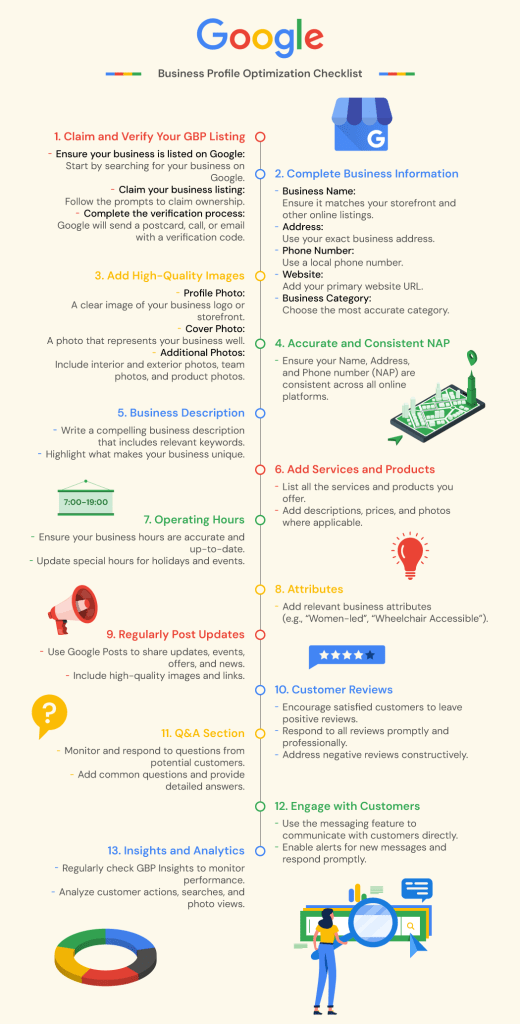
Google Business Profile Optimization Checklist
- Claim and Verify Your GBP Listing
- Ensure your business is listed on Google: Start by searching for your business on Google.
- Claim your business listing: Follow the prompts to claim ownership.
- Complete the verification process: Google will send a postcard, call, or email with a verification code.
- Complete Business Information
- Business Name: Ensure it matches your storefront and other online listings.
- Address: Use your exact business address.
- Phone Number: Use a local phone number.
- Website: Add your primary website URL.
- Business Category: Choose the most accurate category.
- Add High-Quality Images
- Profile Photo: A clear image of your business logo or storefront.
- Cover Photo: A photo that represents your business well.
- Additional Photos: Include interior and exterior photos, team photos, and product photos.
- Accurate and Consistent NAP
- Ensure your Name, Address, and Phone number (NAP) are consistent across all online platforms.
- Business Description
- Write a compelling business description that includes relevant keywords.
- Highlight what makes your business unique.
- Add Services and Products
- List all the services and products you offer.
- Add descriptions, prices, and photos where applicable.
- Operating Hours
- Ensure your business hours are accurate and up-to-date.
- Update special hours for holidays and events.
- Attributes
- Add relevant business attributes (e.g., “Women-led”, “Wheelchair Accessible”).
- Regularly Post Updates
- Use Google Posts to share updates, events, offers, and news.
- Include high-quality images and links.
- Customer Reviews
- Encourage satisfied customers to leave positive reviews.
- Respond to all reviews promptly and professionally.
- Address negative reviews constructively.
- Q&A Section
- Monitor and respond to questions from potential customers.
- Add common questions and provide detailed answers.
- Engage with Customers
- Use the messaging feature to communicate with customers directly.
- Enable alerts for new messages and respond promptly.
- Insights and Analytics
- Regularly check GBP Insights to monitor performance.
- Analyze customer actions, searches, and photo views.
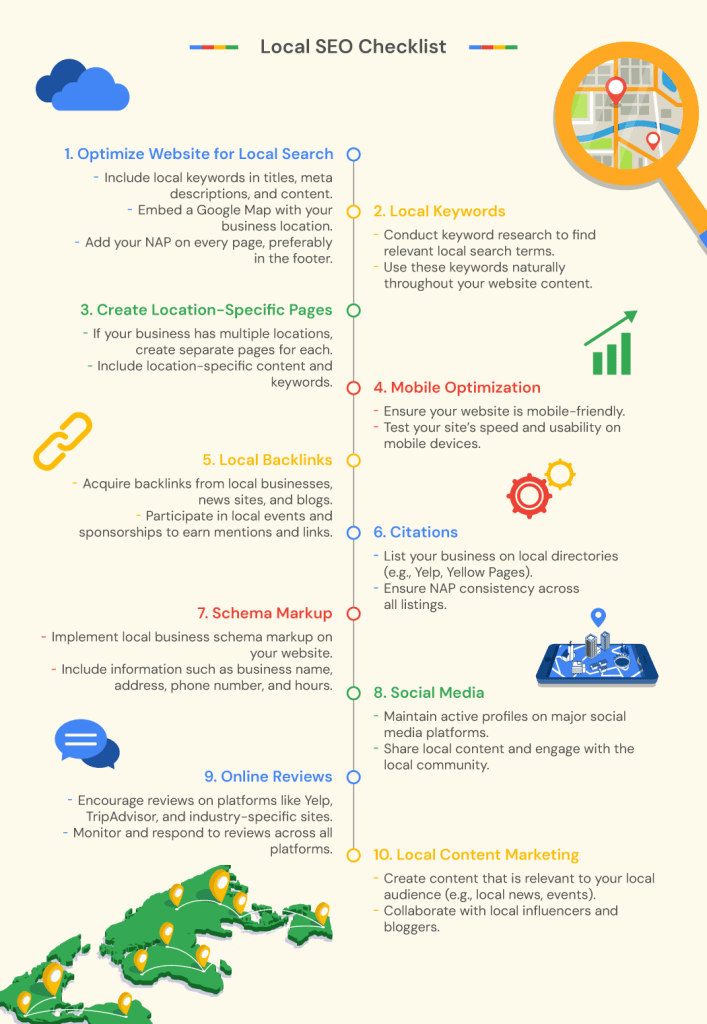
Local SEO Checklist
- Optimize Website for Local Search
- Include local keywords in titles, meta descriptions, and content.
- Embed a Google Map with your business location.
- Add your NAP on every page, preferably in the footer.
- Local Keywords
- Conduct keyword research to find relevant local search terms.
- Use these keywords naturally throughout your website content.
- Create Location-Specific Pages
- If your business has multiple locations, create separate pages for each.
- Include location-specific content and keywords.
- Mobile Optimization
- Ensure your website is mobile-friendly.
- Test your site’s speed and usability on mobile devices.
- Local Backlinks
- Acquire backlinks from local businesses, news sites, and blogs.
- Participate in local events and sponsorships to earn mentions and links.
- Citations
- List your business on local directories (e.g., Yelp, Yellow Pages).
- Ensure NAP consistency across all listings.
- Schema Markup
- Implement local business schema markup on your website.
- Include information such as business name, address, phone number, and hours.
- Social Media
- Maintain active profiles on major social media platforms.
- Share local content and engage with the local community.
- Online Reviews
- Encourage reviews on platforms like Yelp, TripAdvisor, and industry-specific sites.
- Monitor and respond to reviews across all platforms.
- Local Content Marketing
- Create content that is relevant to your local audience (e.g., local news, events).
- Collaborate with local influencers and bloggers.
Continuing Your Local SEO Education
The world of local SEO is constantly evolving, and it’s crucial to stay updated with the latest trends and best practices. Here are a few ways to continue your education:
- Online Courses and Webinars: Platforms like Moz, SEMrush, and HubSpot offer courses and webinars on local SEO.
- Industry Blogs: Follow reputable SEO blogs like Search Engine Land, Neil Patel, and Moz for the latest insights and updates.
- Local SEO Forums and Communities: Join forums and communities such as the Local Search Forum or Reddit’s SEO community to engage with other professionals and share knowledge.
- Books and Ebooks: Read books and ebooks on local SEO to deepen your understanding of strategies and techniques.
Resources for Further Learning
To further enhance your local SEO skills, here are some valuable resources:
- Moz Local Learning Center: A comprehensive resource for local SEO guides and best practices.
- Google’s Local SEO Guide: Official guidelines and tips from Google on optimizing for local search.
- BrightLocal Academy: Offers free courses specifically focused on local SEO.
- Ahrefs Blog: Detailed articles and case studies on various aspects of local SEO.
Conclusion
Optimizing your Google Business Profile and implementing local SEO strategies are essential steps to boost your online presence and attract more local customers. By following this checklist and continuously educating yourself, you’ll be well on your way to dominating local search results. Remember, the key to success in local SEO is consistency and staying informed about the latest trends and best practices.